
Antibiotic stewardship
This page was created in collaboration with the members of the StAR-3 steering group and draws on the Handbook on implementing antibiotic stewardship programms in acute care hospitals in Switzerland.
Formal antibiotic stewardship programm
Staff resources
Staff resources
Formal interdisciplinary coordination meetings
Tools for action
Tools for action
Identification of a standard set of competencies needed for members of an antimicrobial stewardship team.
Reports on quantity of antibiotic use with feedback
Monitoring and reporting of antibiotic consumption is a key component of an ASP, as it helps to identify areas requiring action. This can be implemented either locally or via ANRESIS (the Swiss Centre for Antibiotic Resistance). ANRESIS has been collecting data on antibiotic consumption in hospitals since 2006 and offers additional advantages through its interactive dashboard.
(1) Ensure the hospital joins the ANRESIS platform for monitoring your local antimicrobial consumption
Hospitals should submit antimicrobial consumption data on ANRESIS annually. Participating hospitals get individual feedback and benchmark reports based on their data compared to other hospitals.
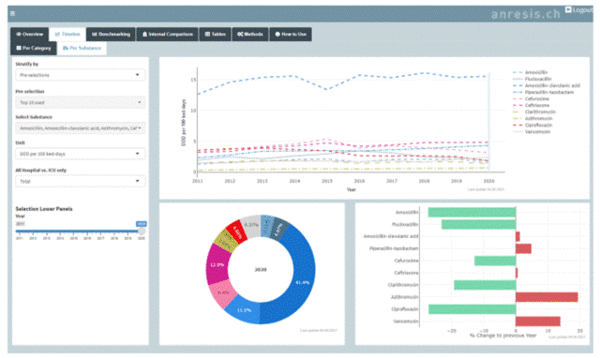
If the hospital considers to set up its own local antimicrobial consumption monitoring:
(i) base consumption monitoring on aggregated consumption data from the local electronic patient record system (if not available, switch to pharmacy delivery data),
(ii) aggregate antibiotic consumption per antimicrobial group and unit,
(iii) report as DDD (daily defined doses) and DOT (days of treatment) per 100 bed days and stratify by WHO AWaRe classification of antibiotics.
(2) Ensure feedback on local antimicrobial consumption data is provided and critically discussed with prescribers
A process must be in place for antimicrobial consumption data to be discussed among the relevant groups (e.g., clinical department leads and within the governance structure). Encourage the discussion of results in meetings with prescribers, especially if consumption increases.
(3) Metrics
Monitoring trends in antimicrobial consumption and audit results provide information on whether prescribing has improved. Site access statistics can give hints as to whether monitoring data are used.
If there is no visible effect, ensure that local practice and the further development of ASP are discussed in relevant committees.
More tools for the local implementation of antibiotic consumption monitoring and reporting are being prepared and will be offered by 2026.
Reports on antibiotic susceptibility patterns with feedback
Regional/national resistance data must be taken into account when developing guidelines for prescribing empirical antibiotic therapy.
(1) Ensure that the hospital has access to epidemiological data on local antibiotic resistance for the most common pathogenic bacteria.
Possible data sources are:
− The associated microbiological laboratory.
− ANRESIS provides regional and national resistance data in a database with an interactive dashboard. In addition, hospitals can request statistics based on local resistance data.
(2) Ensure that epidemiological data on antibiotic resistance is user-friendly and utilised
Resistance statistics should be made available to prescribers at the point of prescription and presented in a user-friendly format (e.g. as a matrix table).
(3) Ensure that antibiotic resistance statistics are up to date
Aim for regular (annual) updates of resistance data.
Clostridioides difficile surveillance
Local Clostridioides difficile infection (CDI) rates supplement the data on antibiotic consumption as an additional indicator. CDI can often be traced back to the use of antibiotics in combination with risk factors and transmission in hospitals.
(1) Establish CDI surveillance
ANRESIS has developed a platform for laboratory data-based CDI surveillance.
Consider connecting your hospital to the ANRESIS system.
(2) Ensure that CDI surveillance is user-friendly and is being used
Ensure that the ASP and IPC have a joint procedure for investigating rising or high CDI rates. This should include investigating transmission in the hospital, prescribing practices and other causes. In addition, recommendations for improvements should be formulated and communicated to the relevant groups (heads of clinical departments and relevant committees).
Tools for action
Tools for action
These tools support the surveillance of antibiotic consumption, antimicrobial resistance and C. difficile infections, and help translate data into targeted stewardship actions.
Interpretation guide : How to read trends and identify signals requiring action.
The WHO AWaRe (Access, Watch, Reserve) classification guides stewardship by recommending that Access antibiotics constitute >60% of consumption, while Watch and Reserve are used cautiously.
Antibiogram tool from ANRESIS : ANRESIS Guide
Decision-support link: How resistance data should inform guidelines and empiric therapy
Perioperative antibiotic prophylaxis
The general principles of perioperative (surgical) prophylaxis include:
− Clean operations without the implantation of a prosthesis or other implant do not justify perioperative prophylaxis.
− Clean or contaminated operations or operations involving the use of implants require perioperative prophylaxis.
− Perioperative prophylaxis is most effective when administered 0-60 minutes before the incision (vancomycin and fluoroquinolones: 60-120 minutes).
− The initial antibiotic dose should not be adjusted for renal function.
− Redosing is necessary if the duration of the procedure exceeds twice the half-life of the antibiotic used.
− If an immediate-type penicillin allergy can be ruled out, a cephalosporin can be used in most cases – in place of other, less effective options.
− Surgical antibiotic prophylaxis consists of a single dose (including possible redosing). Prolonged antibiotic prophylaxis is associated with an increased risk of antimicrobial resistance and increases the risk of adverse events such as renal failure and CDI.
Swissnoso provides a guide to perioperative prophylaxis.
Guidelines for common infections
(1) Ensure that your hospital has local, evidence-based and relevant guidelines in place.
The guidelines should cover empirical antimicrobial treatment and surgical perioperative prophylaxis. They should be based on local/regional data on antibiotic resistance. They should include a system for categorising patients with penicillin allergies and provide information on appropriate treatment options.
Various sources can be used as a basis for local guidelines:
− The Swiss Society of Infectious Diseases offers online guidelines for general medicine and other specialist areas in the outpatient sector.
− Larger hospitals provide access to their guidelines (see list of local guidelines in Switzerland). Some of them contain advice on penicillin allergies.
− Mobile apps that support the decision-making process regarding therapy (e.g. Firstline, Sanford and others).
− Swissnoso provides guidelines for perioperative antimicrobial prophylaxis.
Smaller and medium-sized hospitals are advised to use external guidelines for antimicrobial treatment, e.g. from regional tertiary centres or hospital networks, rather than creating their own guidelines.
(2) Ensure that local guidelines are user-friendly and will be used
Ensure that the guidelines are available at the point of care and guide prescribers through the decision-making process. To encourage prescribers to use the guidelines, ideally integrate them into the local IT system or a smartphone app.
When creating local guidelines for antimicrobial treatment, pay attention to user-friendliness. Use an easily accessible format such as a web application. Structure the guidelines so that they can be integrated into the local IT system at a later date.
Access statistics can provide information on whether the guidelines are being used.
(3) Ensure that guidelines are up to date
A procedure for regularly reviewing and updating local guidelines (recommended at least every three years) should be established in the hospital.
(4) Ensure that guidelines are harmonised
Take into account national recommendations and local trends in antibiotic resistance, the availability of antibiotics, etc.
Guidelines of the Swiss Society for Infectious Diseases
www.ssi.guidelines.ch
Examples of local guidelines by hospital type:
University hospitals
CHUV Guide d’antibiothérapie
HUG https://firstline.org/hug/
Inselspital Bern https://antibiotika.insel.ch
Universitätsspital Basel Sanford Guide + infektioStandards
https://www.sanfordguide.com/products/digital-subscriptions/sanford-guideinfektiostandards/
USZ https://www.usz.ch/fachbereich/infektiologie/ueber-uns/bestellen-sie-unsereantibiotikarichtlinien/
Other hospitals Kantonsspital Baden https://www.kantonsspitalbaden.ch/Departement-Innere-Medizin/Dokumente/ABEmpf2023_v3.pdf
Kantonsspital StGallen https://kssg.guidelines.ch/
Swissnoso guidelines on perioperative antibiotic prophylaxis https://www.swissnoso.ch/fileadmin/swissnoso/Dokumente/6_Publikationen/Bulletin_Artikel_D/v20_1_2015-09_Swissnoso_Bulletin_de.pdf
Education and training on antibiotic prescription
Education & training combined with awareness campaigns reinforce new local routines – such as using guidelines and practicing a new prescription approach.
(1) Ensure the hospital provides education and training on antimicrobial prescription to prescribers and hospital pharmacists
Prescribing doctors, and hospital pharmacists are educated and trained in prescribing practices. Those contents can be included in routine educational activities
and delivered during the induction of new staff.
Education on antimicrobial prescription should also include basic training in diagnostic stewardship. Here, it is recommended to train prescribers on the indications for urinary
culture sampling (to avoid unnecessary antibiotic prescriptions in asymptomatic bacteriuria).
Attendance data can give hints on how many prescribers and hospital pharmacists were educated and trained.
(2) Ensure the hospital educates clinicians, hospital pharmacists and nurses involved in administering antibiotics on the basics of antimicrobial stewardship
The activities aim for healthcare staff to understand the importance of antimicrobial stewardship and the local approach to prescribing. This education can be included in
routine educational activities and delivered during the induction of new staff.
(3) Ensure the hospital raises awareness of antimicrobial stewardship
The hospital provides staff, patients, and visitors, with regular information on local ASP activities, e.g., during the World Antimicrobial Awareness Week.
Tools for action
Tools for action
These tools support education and list available recommendations, helping to translate data into targeted management measures.
The Swiss Society Infectious Diseases Guidelines (SSI Guidelines) platform provides recommendations for common infections.
Examples for local hospital guidelines: in alphabetical order
Guidelines from university hospitals
Centre Hospitalier Universitaire Vaudois
Hôpitaux Universitaires de Genève
Inselspital Bern
Universitätsspital Basel
Universitätsspital Zürich
Guidelines from other hospitals:
Kantonspital Baden
Kantonsspital St Gallen
Swissnoso, in collaboration with other professional societies, published the Guidelines on perioperative antibiotic prophylaxis, including recommendations for the time of administration, the choice of antibiotic and its dosage (including weight adjustment), intraoperative dose repetitions and duration of prophylaxis.
Other educational materials :
Dyar, O. et al. for ESGAP (ESCMID) What is antimicrobial stewardship? Historical background and introduction of antimicrobial stewardship into clinical settings.
Restriction of prescription
ICU ward rounds
ICU ward rounds
Prescription audits with feedback
Audits provide important information about the quality of prescriptions. They are ideally designed as a strategy for quality improvement and are carried out in a supportive environment. Audits should primarily contribute to the reduction of antibiotic therapies and prolonged antibiotic treatments.
Similarly, the use of inappropriate routes of administration and/or the unnecessary use of broad-spectrum antibiotics should be reduced.
(1) Ensure that the hospital participates in national monitoring of antibiotic use (point prevalence study, PPS, and monitoring of surgical site infections, SSI). The recurring measurements provide comprehensive information on antibiotic use. Critical discussion of the results provides a basis for improving the quality of prescribing.
(2) Ensure that a specialist in infectious diseases or a hospital pharmacist participates in ward rounds in the intensive care unit and, optionally, in selected haematological-oncological wards, and provides feedback on antimicrobial prescriptions.
(3) Ensure that the results regarding local practice and antibiotic use are discussed with the prescribers and that improvement measures are discussed.
The audit results can be used to determine whether prescribing practices have improved. If no effect is visible, local practices and the further development of the ASP should be discussed in the relevant committees. The ASP is a voluntary programme. Participation is voluntary and does not entail any legal obligations.
https://www.swissnoso.ch/punktpraevalenz-erhebung/ueber-die-punktpraevalenz-erhebung
Tools for action
Tools for action
Prescription appropriateness